Single-Head Ink Supply Systems
RackFlow System
Industrial Recirculating Ink Supply System
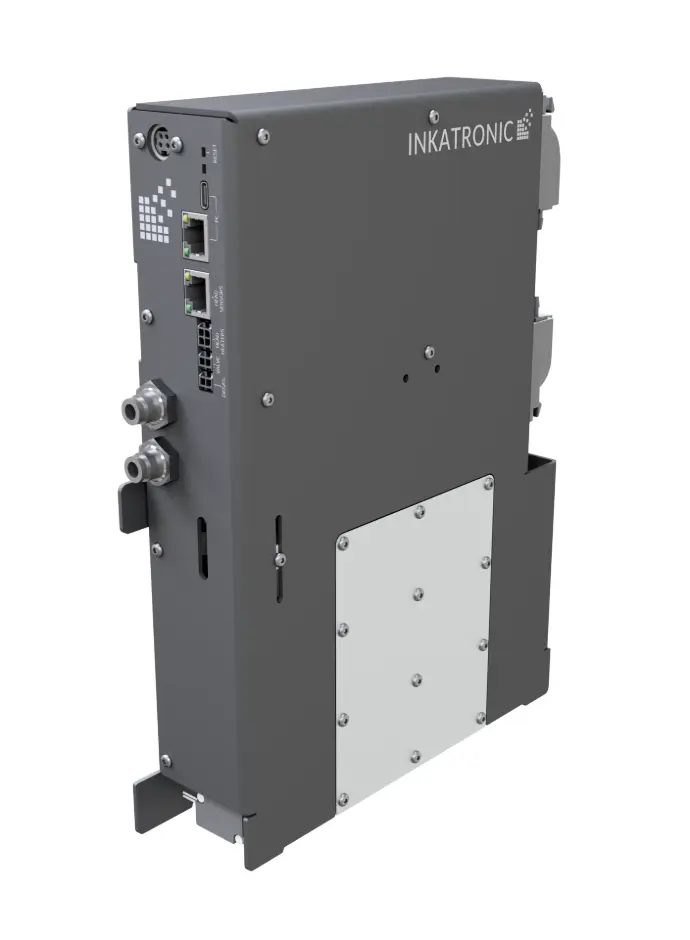
The RackFlow Ink Supply System is Inkatronic’s newest generation of fluidic systems developed for inkjet integrators and OEMs requiring precision, flexibility, and compact integration. Designed around real industrial requirements, RackFlow combines high-precision pressure control, advanced automation features, and modular expandability within a narrow mechanical footprint.
RackFlow Configurations
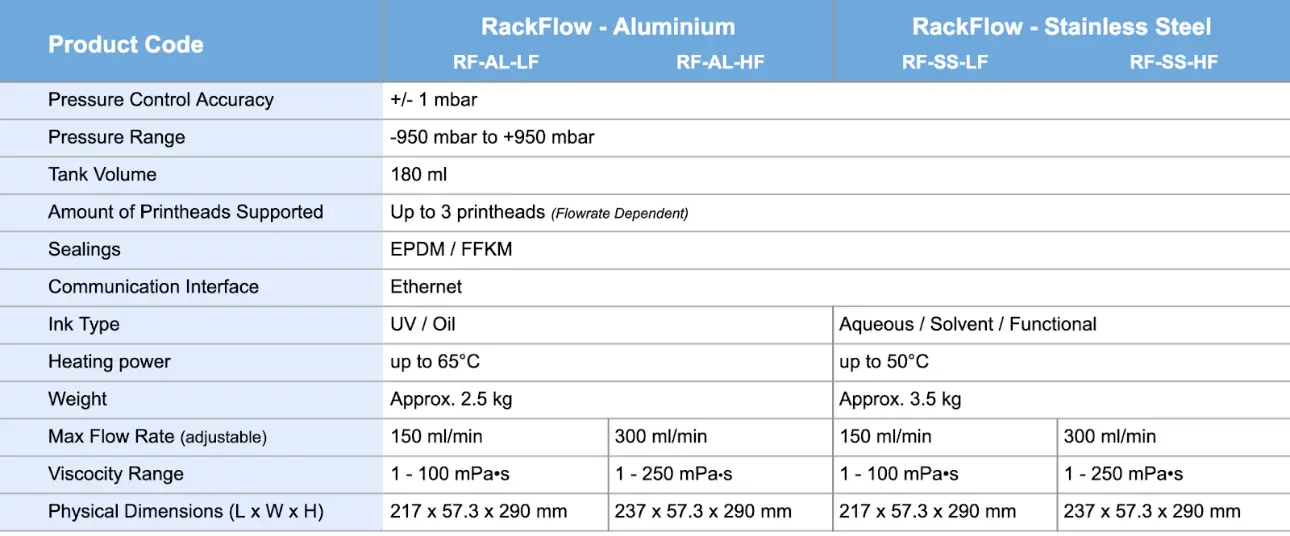
RackFlow is offered in two performance variants and available in two material configurations to ensure optimal compatibility across different chemistry types:
LF (Low Flowrate) - up to 150 ml/min with standard valves
HF (High Flowrate) - up to 300 ml/min with larger orifice valves
RackFLow - Aluminum
Suitable for applications using UV Chemistries.
Recommended for applications requiring higher fluid temperature, and/or high viscosity chemistries.
RackFlow - Stainless Steel
Recommended for applications with Water based or aggressive chemistries.
Pumps and valves are fitted with FFKM membranes and seals to withstand most chemicals.
Designed for Modern Inkjet Integration
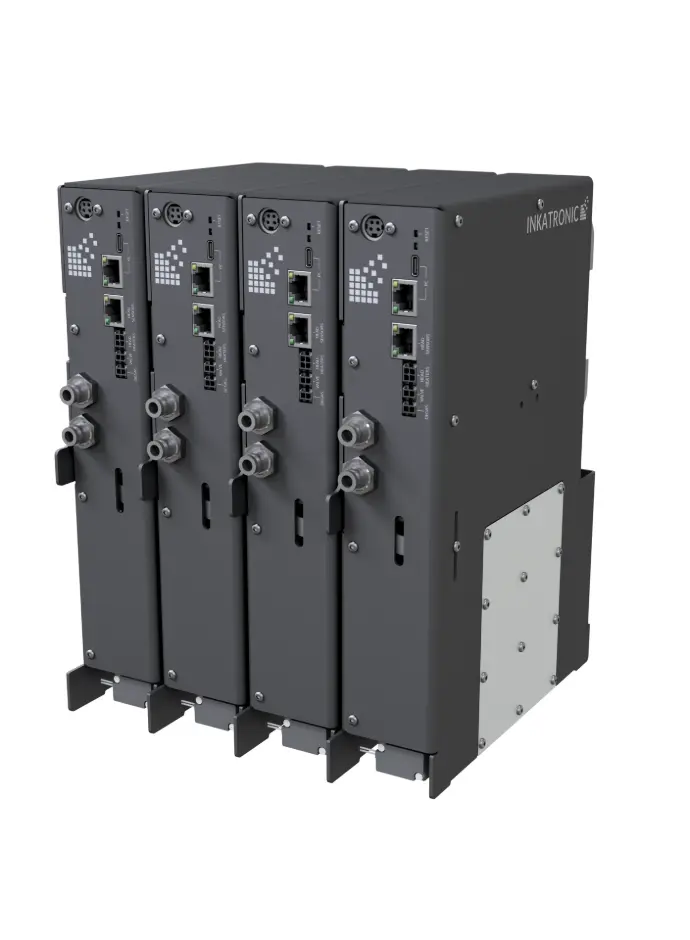
RackFlow enables compact CMYK print modules while supporting both low- and high-viscosity fluids. Key integration advantages:
- Narrow footprint optimized for dense print modules.
- Ethernet communication for modern control architectures
- Compatible with all industrial Drop-on-Demand printheads.
RackFlow Software
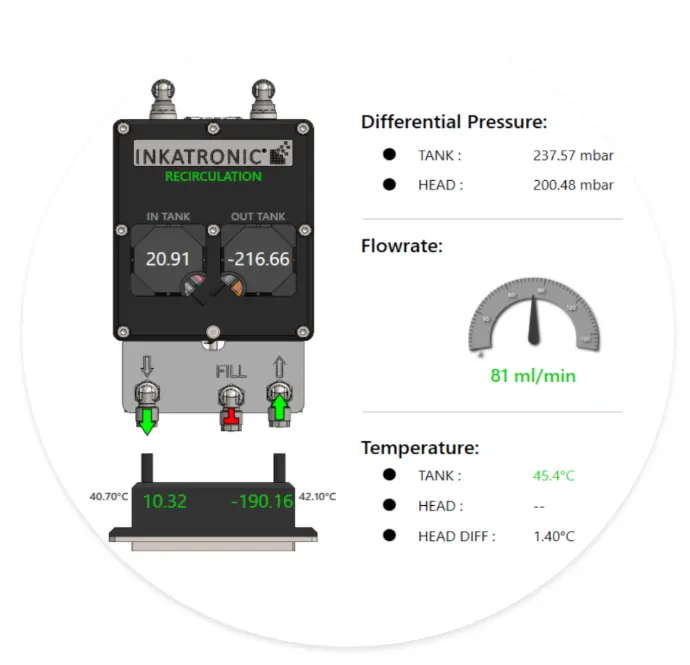
The RackFlow software interface allows precise control of the printhead’s inlet and outlet pressure and temperature. Key advantages include:
- Process parameters are visualized numerically and graphically, including real-time flow rate, differential pressure, meniscus pressure at the printhead.
- An integrated TCP/IP-based API communication protocol, allowing full control of system settings directly through the machine’s main software.
- A dedicated service page permits manual activation of all components, simplifying troubleshooting, commissioning, and remote diagnostics.
Precision Fluid Control
Rackfit is engineered for stable jetting and long-term reliability:
pump control maintaining ±1 mbar pressure stability
Automated draining, priming, and cleaning routines
Integrated hearers and pressure sensors
Low Pulsation membrane pumps
Efficient Integration Support
We assist you in determining the optimal operating parameters for your printhead configuration and adjust the system's control parameters accordingly.
Industrial Safety & Reliability
RackFlow integrates multiple failsafe features:
Normally closed valves preventing ink dripping during shutdown
Continuous pressure monitoring and system diagnostics
printhead air ingestion detection
Overflow prevention mechanisms
Flexible Architecture for OEMs
RackFlow is designed as a scalable platform with optional extensions:
External printhead heater and pressure sensors
Degassing vacuum pump control
External fill pump integration
Configurable I/O expansion
Lab Tank IDS
Suitable for Inkjet Development
The system supports all kinds of piezo inkjet printheads. It consists of two combined ink tanks where filling and emptying the tanks works automatically, allowing for easy and clean exchange of fluids. Each tank has an integrated pressure sensor and powerful heaters that allow for precise control of pressures as well as temperature.
Two external pressure and temperature sensors can be integrated close to the printhead to analyze pressure changes caused by restricting factors in the flow path through the printhead.
Technical Specifications
| Tank Volume | Max Flow Rate | Heating |
Adjustable 80 to 240 ml | 150 or 300 ml/min | Up to 70°C |
Low Volume Lab Tank IDS
When testing new formulations, you want to start working with small batches. INKATRONIC's Low Volume Lab Tank IDS ensures stable circulation of fluids with a minimum of 30ml.
Technical Specifications
| Tank Volume | Max Flow Rate | Heating |
Adjustable 30 to 150 ml | 150 or 300 ml/min | Up to 55°C |

Single-Head Ink Delivery Systems
RackFlow System
Industrial Recirculating Ink Delivery System
The RackFlow Ink Supply System is Inkatronic’s newest generation of fluidic systems developed for inkjet integrators and OEMs requiring precision, flexibility, and compact integration. Designed around real industrial requirements, RackFlow combines high-precision pressure control, advanced automation features, and modular expandability within a narrow mechanical footprint.
RackFlow Configurations
RackFlow is offered in two performance variants and available in two material configurations to ensure optimal compatibility across different chemistry types:
LF (Low Flowrate) - up to 150 ml/min with standard valves
HF (High Flowrate) - up to 300 ml/min with larger orifice valves
RackFLow - Aluminum
Suitable for applications using UV Chemistries.
Recommended for applications requiring higher fluid temperature, and/or high viscosity chemistries.
RackFlow - Stainless Steel
Recommended for applications with Water based or aggressive chemistries.
Pumps and valves are fitted with FFKM membranes and seals to withstand most chemicals.
Designed for Modern Inkjet Integration
RackFlow enables compact CMYK print modules while supporting both low- and high-viscosity fluids. Key integration advantages:
- Narrow footprint optimized for dense print modules.
- Ethernet communication for modern control architectures
- Compatible with all industrial Drop-on-Demand printheads.
RackFlow Software
The RackFlow software interface allows precise control of the printhead’s inlet and outlet pressure and temperature. Key advantages include:
- Process parameters are visualized numerically and graphically, including real-time flow rate, differential pressure, meniscus pressure at the printhead.
- An integrated TCP/IP-based API communication protocol, allowing full control of system settings directly through the machine’s main software.
- A dedicated service page permits manual activation of all components, simplifying troubleshooting, commissioning, and remote diagnostics.
Precision Fluid Control
Rackfit is engineered for stable jetting and long-term reliability:
pump control maintaining ±1 mbar pressure stability
Automated draining, priming, and cleaning routines
Integrated hearers and pressure sensors
Low Pulsation membrane pumps.
Efficient Integration Support
We assist you in determining the optimal operating parameters for your printhead configuration and adjust the system's control parameters accordingly.
Industrial Safety & Reliability
RackFlow integrates multiple failsafe features:
Normally closed valves preventing ink dripping during shutdown
Continuous pressure monitoring and system diagnostics
printhead air ingestion detection
Overflow prevention mechanisms.
Flexible Architecture for OEMs
RackFlow is designed as a scalable platform with optional extensions:
External printhead heater and pressure sensors
Degassing vacuum pump control
External fill pump integration
Configurable I/O expansion.
Low Volume Lab Tank IDS
When testing new formulations, you want to start working with small batches. INKATRONIC's Low Volume Lab Tank IDS ensures stable circulation of fluids with a minimum of 30ml.
Technical Specifications
| Tank Volume | Max Flow Rate | Heating |
Adjustable 30 to 150 ml | 150 or 300 ml/min | Up to 55°C |
Lab Tank IDS
Suitable for Inkjet Development
The system supports all kinds of piezo inkjet printheads. It consists of two combined ink tanks where filling and emptying the tanks works automatically, allowing for easy and clean exchange of fluids. Each tank has an integrated pressure sensor and powerful heaters that allow for precise control of pressures as well as temperature.
Two external pressure and temperature sensors can be integrated close to the printhead to analyze pressure changes caused by restricting factors in the flow path through the printhead.
Technical Specifications
| Tank Volume | Max Flow Rate | Heating |
Adjustable 80 to 240 ml | 150 or 300 ml/min | Up to 70°C |
Control Box for Lab Tank IDS
Each Lab Tank requires a Control Box to function. This houses the main control board as well as the main interface for the PC Controlling the system.
It is possible to use one control box with different Lab Tanks, however, using multiple Lab Tanks at the same time requires each to have its own Control Box.

Control Box for Lab Tank IDS
Each Lab Tank requires a Control Box to function. This houses the main control board as well as the main interface for the PC Controlling the system.
It is possible to use one control box with different Lab Tanks, however, using multiple Lab Tanks at the same time requires each to have its own Control Box.
Lab Tank IDS Material Compatibility
Aluminium Lab Tank [LT-AL]
- Suitable for applications using UV Chemistries.
- Recommended for applications requiring higher fluid temperature, high viscosity chemistries.
Stainless Steel Lab Tank [LT-SS]
- Recommended for applications with Water based or aggressive chemistries.
- Pumps and valves are fitted with FFKM membranes and seals to withstand most chemicals.
Lab Tank IDS - Optional add-ons
- Universal Sensor Block
- Degassing Module
- Fill & Drain Pump
- External Headmount Heaters
INKATRONIC Lab Tank IDS Software
The software required to manage the IDS (Ink Delivery System) is included with the Lab Tank.
The software’s main view allows the operator to control the printhead’s inlet and outlet pressure and temperature.
The outcome of these parameters can be numerically and graphically visualized in the form of flow rate and differential pressure and temperature at the printhead. Such features are helpful when analyzing and tuning the flow behavior of different chemistries and printheads.

INKATRONIC Lab Tank IDS Software
The software required to manage the IDS (Ink Delivery System) is included with the Lab Tank.
The software’s main view allows the operator to control the printhead’s inlet and outlet pressure and temperature.
The outcome of these parameters can be numerically and graphically visualized in the form of flow rate and differential pressure and temperature at the printhead. Such features are helpful when analyzing and tuning the flow behavior of different chemistries and printheads.
